Table of contents
You're doing many of the right things already. You wear an Oura ring or WHOOP. You cut back on alcohol. You keep your bedroom cool. You may even take melatonin, magnesium, or a sleep gummy. Yet bedtime still feels like a negotiation. Your body is tired, but your brain keeps a foot on the gas.
That pattern often gets labeled as “stress,” which is true but incomplete. The more useful lens is timing. Cortisol isn't just a hormone that goes up when life gets hard. It's part of a daily rhythm, and when that rhythm shifts into the evening, sleep can break down even if your total cortisol output doesn't look dramatic.
That's why people with strong habits still get stuck. They focus on lowering stress in general, while the underlying issue is often a mistimed stress signal. If cortisol remains high during the part of the day when it should be dropping, your biology interprets that as a cue to stay alert. Sleep becomes shallower, shorter, or delayed.
The practical takeaway is simple. If you want to improve cortisol levels and sleep, stop asking only, “Is cortisol high?” Ask, “When is cortisol high?” That question changes what you measure, what you ignore, and what you do about it.
Introduction The Wired but Tired Paradox
The “wired but tired” state has a recognizable signature. You push through the day on momentum, feel oddly alert late at night, then wake up feeling like sleep happened around you rather than for you. Your tracker may show enough time in bed, but you don't feel restored.
That mismatch is where many smart sleep strategies fail. People treat sleep as a nighttime event. Biology treats it as the final act of a full-day hormonal sequence. If that sequence is off, bedtime becomes the place where the problem shows up, not where it started.
Why timing matters more than most people realize
Cortisol should support wakefulness earlier in the day and get out of the way later. When that decline stalls, your body can feel sleepy and activated at the same time. That's the paradox. You're fatigued at the level of energy availability but alert at the level of threat detection.
A useful analogy is airport traffic control. Sleep doesn't begin just because one plane is ready to land. The whole runway system has to clear. Melatonin, adenosine, body temperature, light exposure, meal timing, and cortisol all have to coordinate. If cortisol stays high too close to bedtime, it acts like a plane still occupying the runway.
For high performers, this often hides in plain sight. Evening work intensity, late workouts, inconsistent schedules, long light exposure, and “catch-up sleep” on weekends can all shift the curve. The result isn't just trouble falling asleep. It's non-restorative sleep, more nighttime awakenings, and a next-day system that's less resilient.
The optimization lens
The goal isn't to wage war on cortisol. You need it. It helps you wake, focus, and respond to demands. The goal is rhythm. Good sleep usually comes from a strong morning signal and a clean evening decline.
If you've been chasing generic advice and still feel off, that doesn't mean you're doing sleep wrong. It usually means your data needs a clock, not just a score.
Your Body's Internal Clock The Cortisol Rhythm
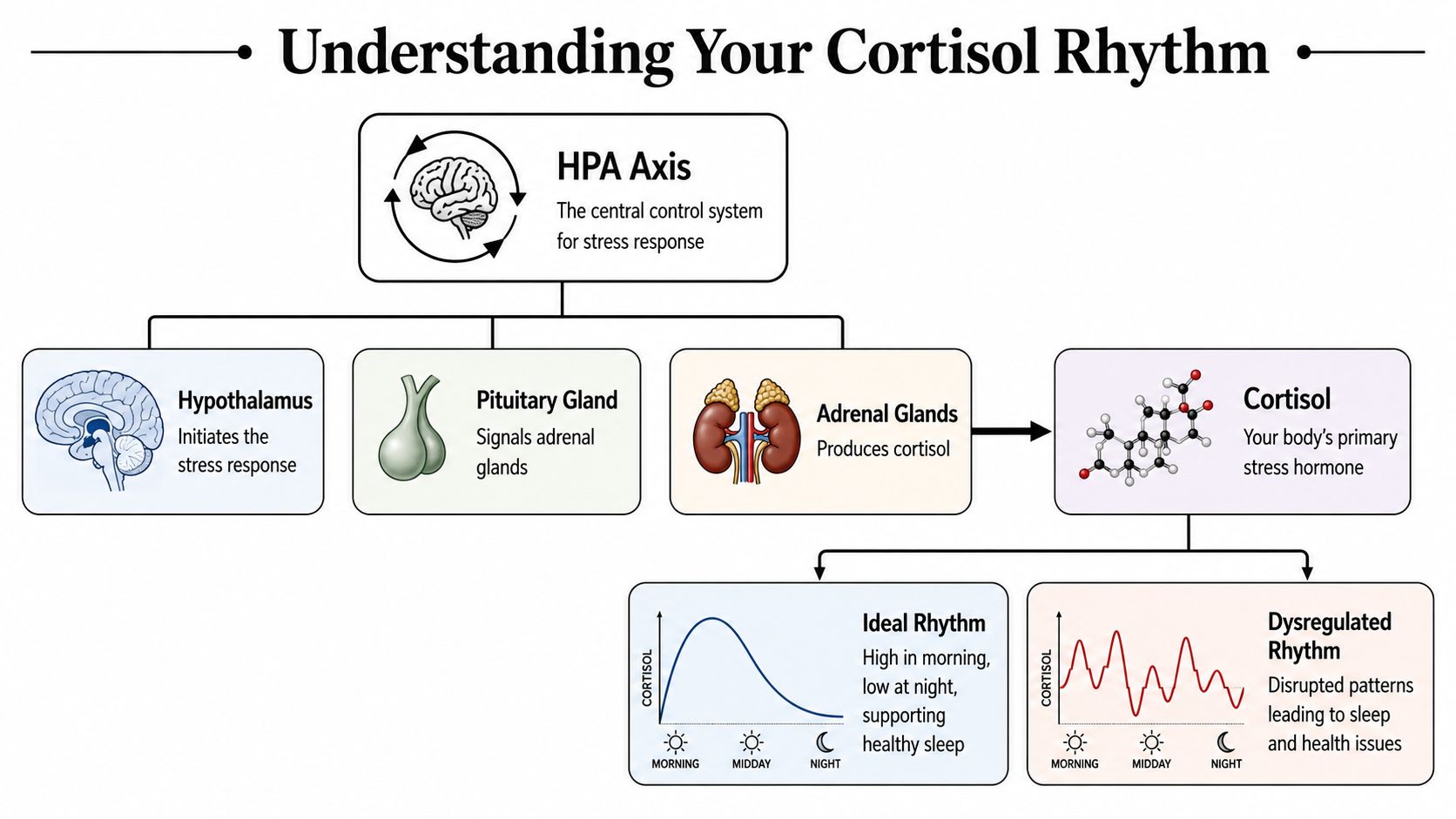
Cortisol works best as a rhythm, not a static level. Think of the HPA axis as a leadership chain. The hypothalamus detects conditions, the pituitary relays instructions, and the adrenal glands execute by releasing cortisol. When that chain is aligned, cortisol supports alertness early and quiets down late.
What a healthy curve does
In a stable rhythm, cortisol helps you transition into the day, mobilize energy, and coordinate with other circadian signals. By night, it should be low enough to stop competing with the chemistry of sleep onset.
Research shows the cortisol nadir typically occurs near midnight, and when cortisol rises during this nighttime period, it can interfere with melatonin production and disrupt restorative sleep onset, as summarized in this review of sleep restriction and circadian effects on cortisol. The same review notes that acute sleep restriction can redistribute cortisol toward the evening even when total 24-hour exposure doesn't necessarily change.
That distinction matters. A person can have a rhythm problem without having an obvious “too much cortisol” problem across the whole day.
Why total output can miss the real issue
Many people think cortisol is like a fuel tank. More or less. Healthy or unhealthy. In practice, it's closer to a playlist. The sequence matters. Play the right song at the wrong moment and the whole experience feels off.
Here's what a functional cortisol rhythm supports:
Morning alertness: You wake with some drive rather than dragging yourself into motion.
Daytime stability: Energy stays more predictable instead of swinging between stimulation and collapse.
Evening shutdown: The nervous system receives a clear signal that the workday is ending.
Sleep initiation: Melatonin and sleep pressure don't have to compete with a late alertness signal.
The HPA axis is a scheduling system
If the HPA axis is the corporate office, cortisol is the daily calendar invite. Early invites say “start the meeting.” Late invites keep everyone in the building after hours.
That's why cortisol levels and sleep are so tightly linked to modern routines. The biology still expects strong light in the morning, relative darkness at night, and a fairly coherent schedule. It doesn't adapt cleanly to endless overhead lighting, laptop work in bed, and social jet lag.
Once you view cortisol as a timing system, the next step becomes clearer. You don't just ask whether sleep is bad. You ask what kind of sleep disruption created the curve you're now living with.
How Poor Sleep Hijacks Your Cortisol Curve
Sleep disruption doesn't produce one uniform cortisol pattern. That's where a lot of advice goes wrong. It lumps together all-nighters, short sleep, rotating shifts, and irregular bedtimes as if they stress the body in the same way. They don't.
Acute loss versus chronic misalignment
Clinical evidence shows that acute total sleep deprivation significantly increases cortisol, especially in the early evening and early morning, with a statistically significant effect reported at p<0.0001 in this study on sleep deprivation, circadian misalignment, cortisol, and inflammation. The same study found the opposite pattern with chronic circadian misalignment, which significantly reduced 24-hour cortisol levels across the day.
That gives you two very different biological stories:
Acute sleep deprivation: The body reacts like it needs to stay online. Cortisol rises at times that can make you feel overstimulated and off.
Chronic circadian misalignment: The rhythm becomes blunted. You may feel less sharply stressed but more chronically dysregulated.
For someone reviewing wearable data, these patterns can look deceptively similar because both can produce poor recovery. The difference is in the mechanism.
What this looks like in real life
The all-nighter pattern is familiar. You miss a full night of sleep, then feel strangely alert at the wrong times, hungry at odd hours, and unable to settle the next evening. That's not just fatigue. It's a shifted stress signal.
The chronic misalignment pattern is more subtle. Think rotating shifts, very late work nights, frequent timezone changes, or weekday-weekend schedule swings. Over time, the system stops generating a clean rise-and-fall pattern. You may stop feeling “stressed” in the dramatic sense while still losing resilience.
A practical clue often shows up in metrics people already track. If your sleep efficiency keeps drifting despite decent sleep opportunity, it's worth asking whether schedule inconsistency rather than simple sleep quantity is driving the problem.
The strategic mistake is treating every bad night as a willpower problem. Sometimes the issue isn't that you need better discipline. It's that your physiology is adapting to the wrong signal.
How High Cortisol Sabotages Restorative Sleep
Once evening cortisol climbs above your normal pattern, sleep gets harder in ways that feel personal but are mostly mechanical. The brain doesn't care that you want to sleep. It cares whether the internal environment says the coast is clear.
The within-person effect matters most
One of the most useful findings in this field is that the relationship shows up within the same person, not just between different people. In a study with 15 days of intensive longitudinal monitoring, researchers found that on nights when a person's pre-sleep cortisol was higher than their own average, they had shorter total sleep time, lower sleep efficiency, and longer sleep onset latency that night, according to this Sleep journal study on nightly cortisol fluctuations and objective sleep.
That's a far more actionable result than saying “stressed people sleep worse.” It means your personal baseline matters less than your deviation from it. You don't need to be a chronically high-cortisol person for cortisol to impair sleep. You just need a late spike on that particular evening.
Why sleep aids can disappoint
Many people misunderstand this point. A sleep aid may help induce sleep, but it doesn't automatically fix the hormonal setting in which sleep occurs. If cortisol remains at a high level, the night can still feel thin.
Mechanistically, high evening cortisol acts like an “on” signal. It competes with the processes that normally support deeper, restorative sleep. You may get unconsciousness without full restoration.
Here's the lived pattern:
Falling asleep feels effortful: You're tired, yet your mind keeps scanning.
Sleep becomes lighter: Small noises, temperature shifts, or thoughts wake you more easily.
Morning feels unearned: Time in bed happened, but repair didn't.
The sleep debt trap
High evening cortisol also sets up the next day. You wake less restored, depend more on caffeine, push harder to stay productive, then recreate the same late activation. It becomes a loop disguised as a busy lifestyle.
This is why “just relax” advice misses the point. Restorative sleep isn't only about subjective calm. It's about whether the timing of your stress biology matches the stage of the day.
Measuring What Matters Cortisol and Sleep Data
You can't optimize what you only describe emotionally. “I feel stressed” and “I'm sleeping badly” are useful starting points, but they won't tell you whether the issue is a shifted evening rise, a flattened daily curve, or a mismatch between your lab pattern and your nightly recovery data.
Lab testing and wearable data answer different questions
Cortisol testing can map the biological signal. Wearables can show how that signal behaves in everyday life. Used together, they're far more informative than either alone.
People exploring understanding cortisol levels often start by asking which test is “best.” That's the wrong framing. The better question is which test matches the pattern you're trying to identify.
Cortisol Testing Methods Compared
Method | What It Measures | Best For | Pros | Cons |
|---|---|---|---|---|
Saliva, multiple points per day | Daily rhythm across several time points | Mapping the shape and timing of the cortisol curve | Best view of diurnal pattern; useful when evening dysregulation is suspected | Requires careful timing and adherence |
Serum, single draw | A snapshot at one point in time, often morning | Basic screening when a clinician wants a simple reference point | Easy to access in conventional settings | Misses the full-day rhythm |
Hair analysis | Longer-term average exposure | Broad trend assessment over time | Useful for long-view context | Doesn't show daily timing or bedtime dynamics |
What wearables can contribute
Wearables don't measure cortisol directly, but they do capture downstream behavior of the system. If late cortisol is part of your problem, you may see a cluster rather than a single red flag.
Look for patterns such as:
Higher nighttime resting heart rate: The body may be staying activated after lights out.
Lower HRV trend: Recovery capacity may be compressed when the stress system doesn't disengage.
Fragmented sleep architecture: More awakenings or lighter sleep can signal a poor physiological handoff into the night.
Reduced readiness or recovery scores: These can help contextualize whether a bad night was random or part of a multi-day loop.
If you want one metric to compare with subjective stress and sleep quality over time, a stress score biomarker view can be useful because it helps organize daily fluctuations instead of treating each rough night as an isolated event.
The question your data should answer
Many people wonder why sleep aids don't fix the issue. One reason is that sleep loss can increase evening cortisol by 37 to 45 percent, disrupting the decline needed for sleep onset, and that increased evening cortisol can persist even if sleep is induced, as described in this analysis of evening cortisol after sleep loss.
That points to a practical rule. If your symptoms say “insomnia” but your pattern says “evening activation,” the intervention target changes. You don't just knock yourself out. You work to restore the late-day decline.
Connecting Your Data for a Unified Health View
A single metric rarely tells the full story. A flattened cortisol curve by itself is interesting. Low deep sleep by itself is interesting. A few nights of high resting heart rate by itself might mean nothing. Combined, they become a pattern.
Pattern recognition beats isolated data points
The most useful view is layered. You line up subjective symptoms, wearable recovery trends, and lab timing. That's how you distinguish “I had a bad week” from “my stress-sleep loop is now self-sustaining.”
One important finding is that the loop runs in both directions. Research shows a bidirectional cycle in which higher pre-sleep cortisol predicts worse sleep that night, while shorter and poorer sleep leads to a flatter diurnal cortisol slope the following day, an indicator of impaired HPA-axis regulation, according to this longitudinal analysis of cortisol and sleep.
That flatter slope matters because it suggests the system is losing its ability to shift cleanly from activation to recovery.
What a unified view reveals
When you put data streams together, four things become easier to see:
Recurring timing errors: Late work, late meals, or late exercise may map cleanly to poorer nights.
Recovery bottlenecks: HRV, resting heart rate, and sleep quality may all worsen before you consciously feel burned out.
False reassurance: A decent total sleep duration can hide poor physiological quality.
Intervention fit: The right fix depends on the pattern. Someone with acute overactivation needs a different approach than someone with chronic rhythm blunting.
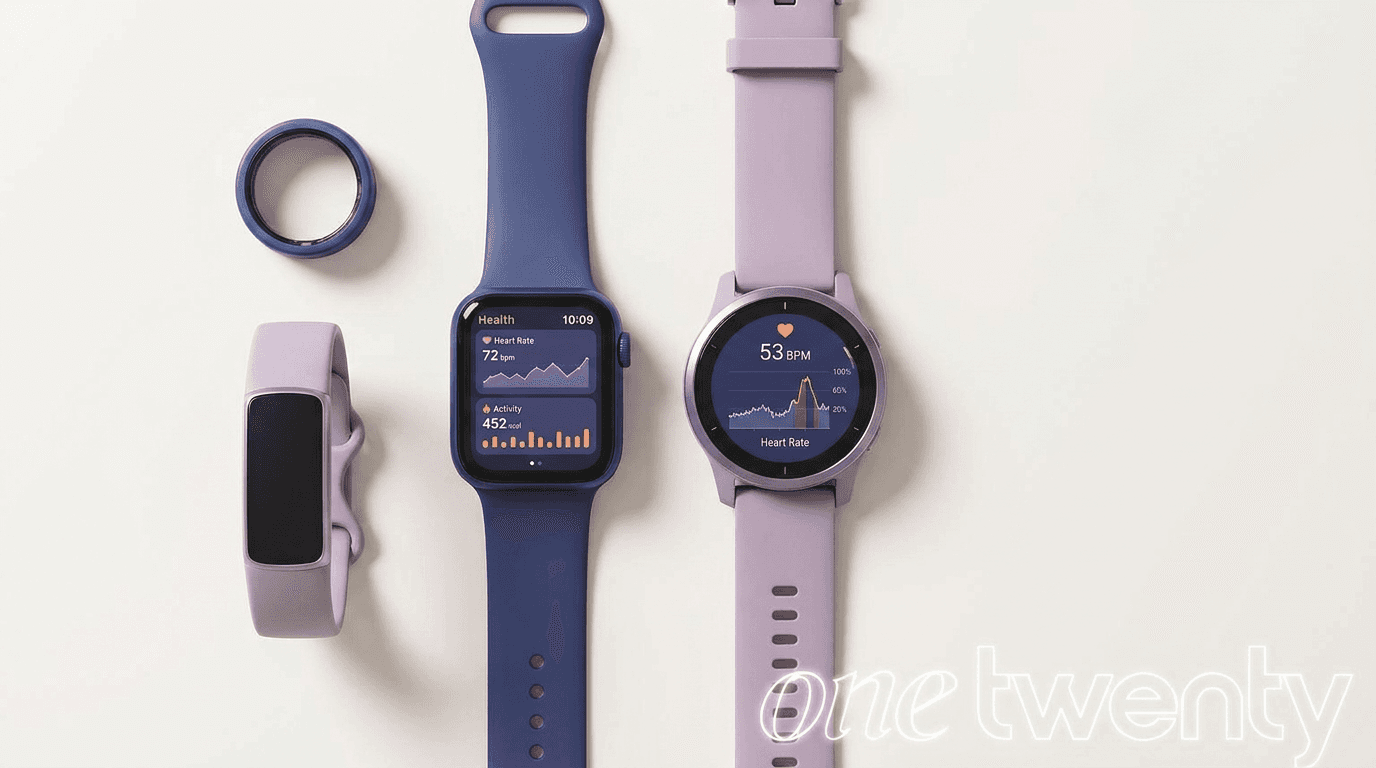
If you're comparing devices, this guide to suggested wearables for health tracking is useful because consistency of data collection matters more than gadget novelty.
For a quantified-self audience, that's the key. You stop treating bedtime as the whole problem and start managing the full loop.
Actionable Protocols to Resync Your Rhythm
The best protocol depends on timing. If your problem is evening activation, generic “stress reduction” advice is too blunt. You need habits that strengthen the morning rise and protect the evening decline.
Morning and daytime anchors
Start with signals that tell your body when the active phase begins.
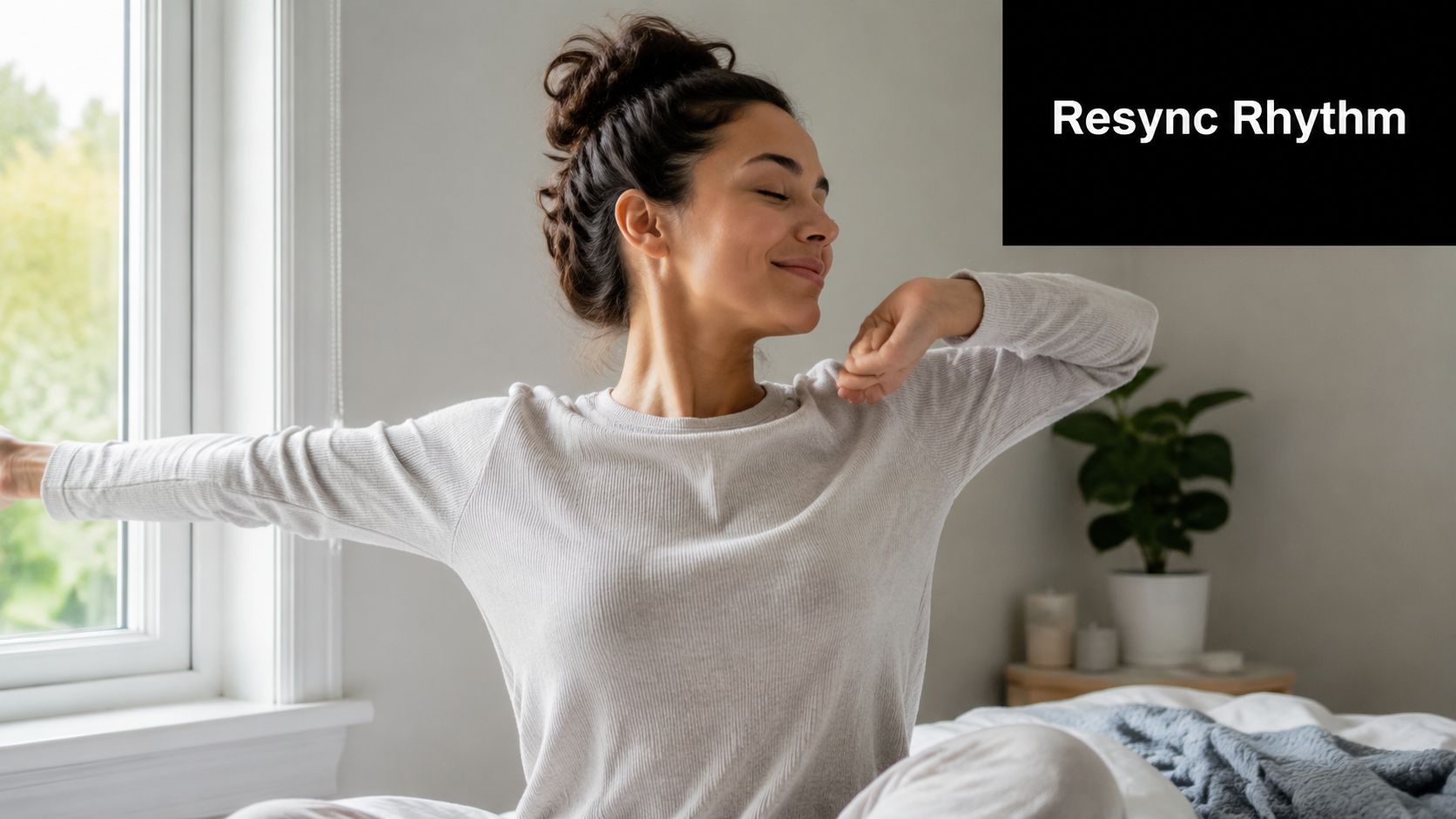
Morning light exposure: Get outside soon after waking. Outdoor light is a stronger circadian cue than indoor light.
Front-load stimulation: Put caffeine and intense exercise earlier in the day if bedtime feels mentally “loud.”
Keep wake time stable: Consistency matters because the cortisol rhythm is easier to regulate when your clock isn't moving.
Late-day downshift
The evening job is different. You're not trying to become sleepy by force. You're trying to remove conflicting signals.
Reduce cognitive intensity: Hard strategic work late at night often bleeds into physiology.
Use a downshift ritual: Breathing, stretching, reading, or a warm shower can create a repeatable cue.
Consider a small evening carbohydrate snack if late alertness pairs with restlessness: For some people, that timing feels more settling than going to bed under-fueled.
For readers working on managing anxiety for restorative sleep, practical wind-down strategies can help if the main issue is nervous system overactivation rather than simple insomnia habits.
A short guided reset can also help transition out of work mode before bed:
A simple rule for testing change
Change one timing variable at a time for several nights. Move caffeine earlier. Shift workouts earlier. Tighten wake time. Reduce bright light at night. Then compare how you feel with your wearable trends. The body responds to rhythm faster than one might expect, but only if the signal is consistent.
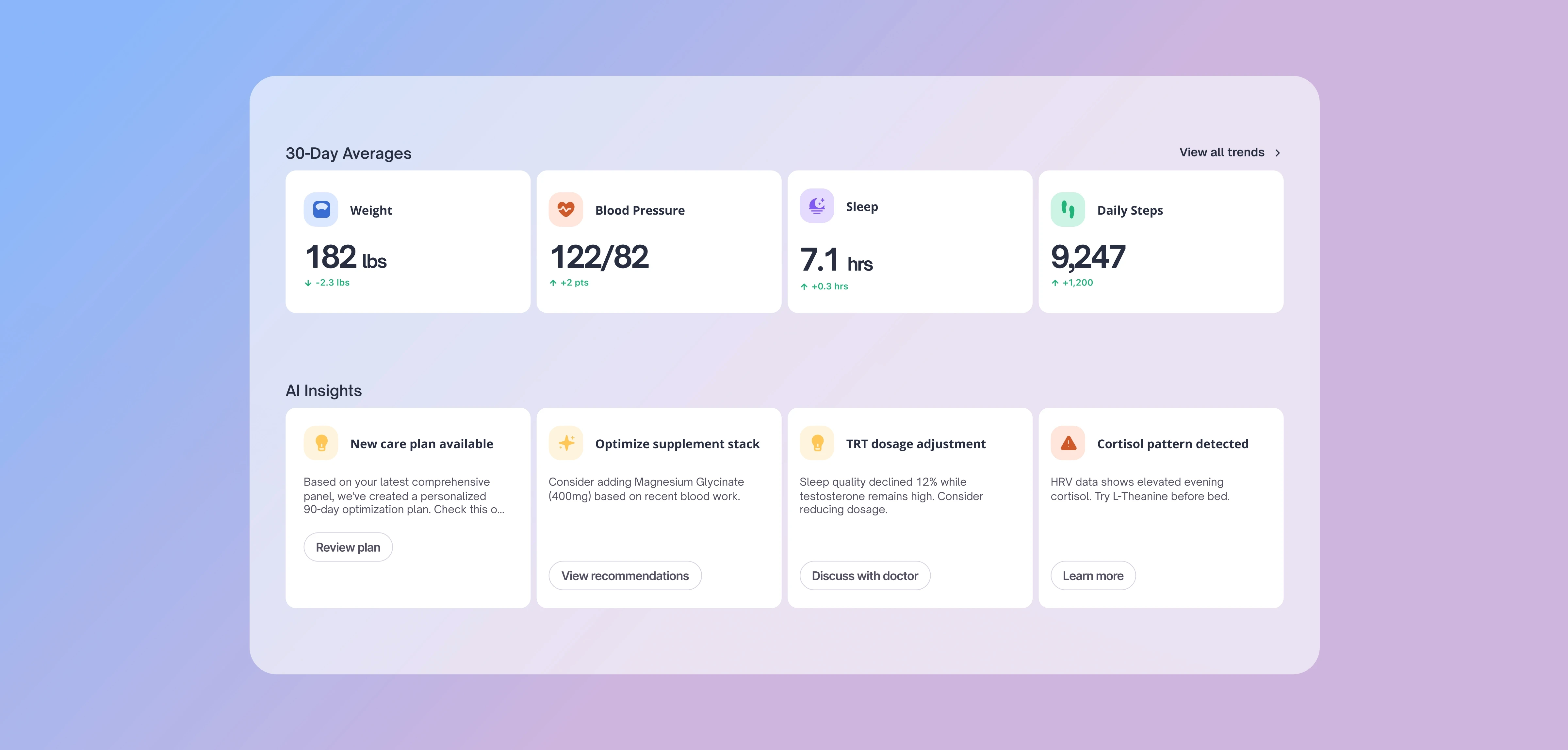
OneTwenty helps you connect the dots between wearable trends and lab data so you can see whether your sleep problems are really a timing problem. If you want a clearer, unified view of stress biology, recovery, and long-term health risk, explore OneTwenty.
How OneTwenty Works
Not your average
Checkup.
Every life stage brings new biological demands. Tracking the right metrics at the right time helps you adapt, optimize performance, and extend both lifespan and healthspan.
Your Annual Physical
Manual Data Processing
Guesswork Trend Detection
Once-a-year physical
Reactive, tested when sick
No data between visits
Once a year testing
Delayed Results
One-size dosing, set and forget
Real-Time Trend Insights
Daily smart-device data
Automated Data Sync
Quarterly Biomarker Tests
Optimal, personalized targets
Plain-language AI insights
Medications titrated to your data
Built to extend healthspan

Frequently Asked Questions
Clarity before
you commit
Answers on setup, scale, and support to remove blockers.